Yavatmal · Maharashtra

Our story

A local beginning.
A continuing record.

Saiprem Gramin Vikas Sanstha began in Yavatmal in 1997. Its work has grown through schools, village meetings, health programmes, watershed structures and practical training.

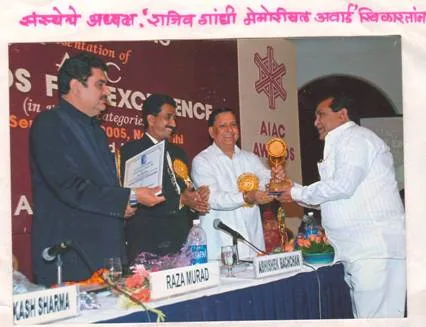
Men receiving recognition at an SGVS award ceremony
Plate 06 · An SGVS recognition event.

“Real India
lives in villages.”

This belief is the foundation of SGVS’s work.

SGVS is a non-profit, non-governmental organization working in rural development, education, health and social welfare. Its programme history includes community health, watershed management, women’s self-help groups, village water and sanitation, education and capacity building.

Over time, this work has taken the organization beyond Maharashtra into training and implementation-support roles in Madhya Pradesh, Chhattisgarh and Odisha.

Read the organization background

Purpose

The purpose
behind the programmes.

Our vision and mission guide our work with communities.

01 / Vision

Young people with the capacity to respond.

To nurture among young people a spirit of sportsmanship, social service and co-operative teamwork, with the capacity for a ready and vital response to challenging situations, and the endurance to see the work through.

02 / Mission

Sustainable remedies, built with people.

To pursue sustainable solutions for people, to work for the empowerment of women and girls, and to strengthen society through thoughtful, dedicated service.

What we set out to do

An agenda
for rural life.

The organization’s stated objectives span education, health, livelihoods and the social life of rural communities.

01

Education & opportunity

Run schools, colleges, balwadis and anganwadis for boys and girls; offer technical education and training; support SC and ST students through educational and government schemes.

02

Health & care

Run a rural hospital, organise health check-up camps and provide ambulance services; support women’s, children’s and family welfare.

03

Rural development & livelihoods

Work through self-help groups, watershed programmes and tree plantation; promote rural and cottage industries, agricultural business and Khadi Gram Udyog training.

04

Community life & inclusion

Support hostels, ashrams and old-age homes; encourage sport, teamwork, cultural programmes and social welfare initiatives.
History

The work
over time.

A history of service, community work and programme development.

  1. 1981

    A commitment to service

    Ramesh D. Bhanwe begins his community service.

  2. 1995

    Datta Seva Samiti

    The organization’s account records his association with Datta Seva Samiti from 1995.

  3. 1997

    SGVS is established

    Founded in Yavatmal with six others. Society registration follows on 17 December 1997; trust registration on 6 June 1998.

  4. 2002

    Schools, coaching and health

    SGVS begins work in education, coaching, family planning, tree plantation, adult education and AIDS control.

  5. 2004

    Recognition

    SGVS receives the Priyadarshani Indira Gandhi Award, Outstanding National Citizen Award and GEM of India Award.

  6. 2021

    Jal Jeevan Mission

    Implementation support in Kalamb and Key Resource Centre training across six districts in three states begin.

  7. 2023

    Swachh Bharat Mission II

    Two-day training programmes on solid and liquid waste management are recorded for Yavatmal, Pune and Palghar in 2023–2024.

  8. NAMASTE

    NAMASTE and the complete profile

    Field surveys under NAMASTE begin in Maharashtra and Odisha. The organization documents its programmes and field record.

Where we work

From Yavatmal
outward.

SGVS has worked with communities in four states.

Maharashtra

7 places recorded

Yavatmal, Kalamb, Ghatanji, Umarkhed, Babulgaon, Amravati, Pune and Palghar

The organization’s home state and the centre of its school, health, watershed and sanitation work.

Madhya Pradesh

1 places recorded

Narmadapuram and Harda

Jal Jeevan Mission capacity building, with a sub-office recorded in Harda.

Chhattisgarh

1 places recorded

Dantewada and Balodabazar

Jal Jeevan Mission training on village water systems, water quality and source sustainability.

Odisha

6 places recorded

Kendujhar, Khordha, Koraput, Mayurbhanj, Puri, Rayagada and Subarnapur

Field surveys for NAMASTE.

How a programme moves

From a proposal
to a closure report.

Eight working stages connect planning, local coordination, implementation, review and reporting.

See the working model
  1. 01Project proposal
  2. 02Grant approval / MoU
  3. 03Induction with stakeholders and partners
  4. 04Coordination with local government and partners
  5. 05Programme implementation
  6. 06Evaluation and feedback
  7. 07Reporting
  8. 08Closure

Meet the people
behind the record.

The founder, director, secretary and trustee body are part of the institution’s continuing story.

WhatsApp SGVS