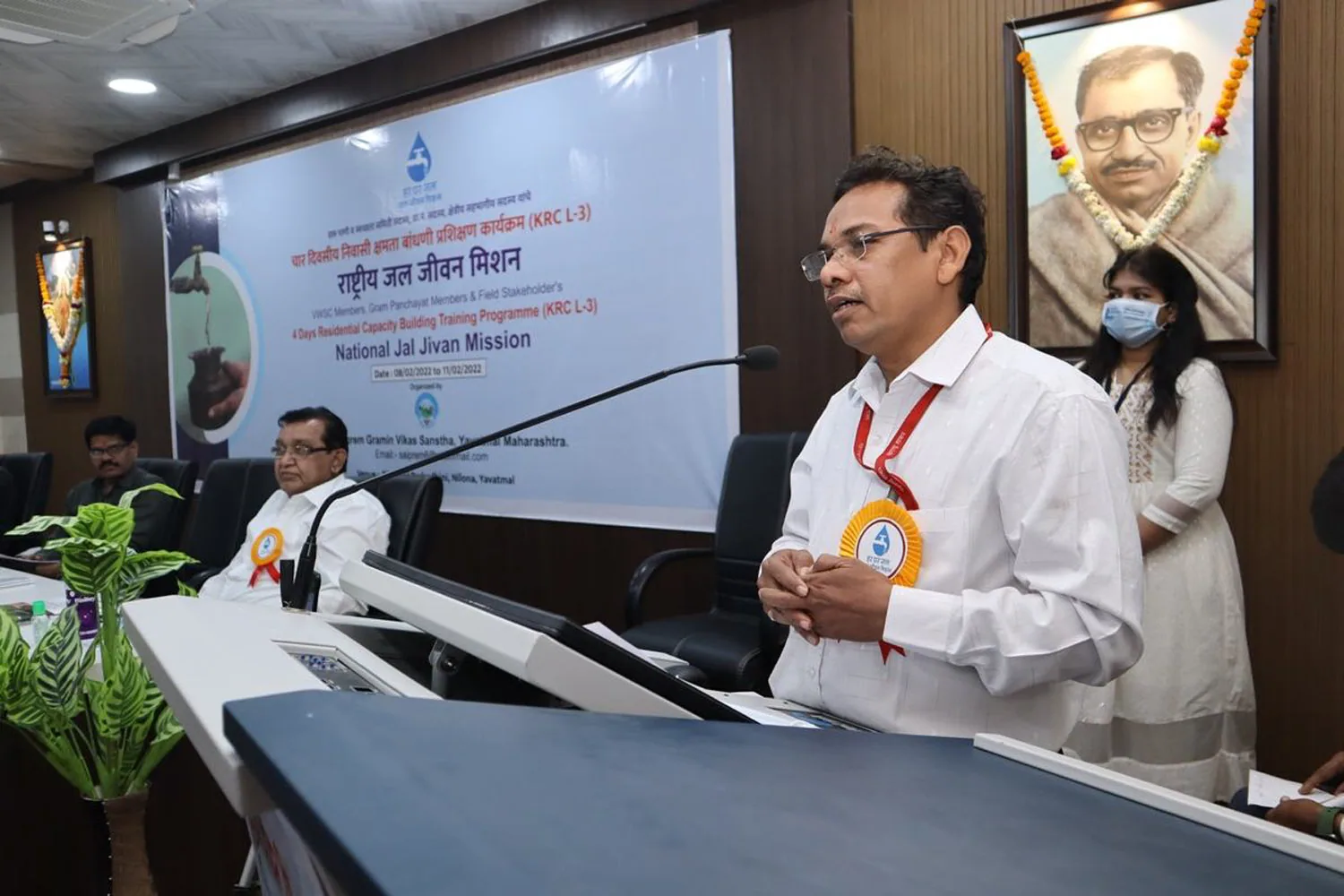
A speaker at the Jal Jeevan Mission KRC Level 3 training, with the programme banner behind

Jal Jeevan Mission · KRC Level 3

Jal Jeevan Mission.
The people behind the taps.

Village water planning, practical training and source sustainability, with SGVS working as an Implementation Support Agency and a Key Resource Centre.

From 2021; contact SGVS for current statusSix districts · three statesRole: ISA and KRC Level 3
Role
Implementation Support Agency in Kalamb; Key Resource Centre, KRC Level 3
Documented area
Yavatmal and Pune, Maharashtra; Narmadapuram and Harda, Madhya Pradesh; Dantewada and Balodabazar, Chhattisgarh
Working period
From 2021; contact SGVS for current status
Funding
Government of India and State Governments

Why it matters

A water system is not
only a tap.

Infrastructure can be built. The knowledge to run it, maintain it and protect its source has to live in the village.

SGVS’s role in Jal Jeevan Mission combines village-level implementation support with training for the people who carry responsibility for village water systems: Gram Panchayat members, village water and sanitation committees, self-help groups and field stakeholders.

The programme includes four training phases — an introduction to the mission, operation and maintenance, water literacy, and source sustainability — along with two further phases on water quality for women and Jalsurakshaks.

The training programme

Four phases
of practical learning.

The programme has four training phases. Two additional water-quality phases were conducted for women and Jalsurakshaks.

  1. Phase 01

    Introduction to Jal Jeevan Mission

    The mission, safe drinking water, hygiene, stakeholder responsibilities and the role of community participation.

  2. Phase 02

    Operation, maintenance and repair

    Practical training for the people responsible for keeping village tap-water supply schemes working.

  3. Phase 03

    Jalsaksharta

    Water literacy: understanding the resource, the scheme and the responsibilities that come with a household connection.

  4. Phase 04

    Source strengthening and sustainability

    Looking beyond the tap to the source, its protection and the long-term sustainability of the scheme.
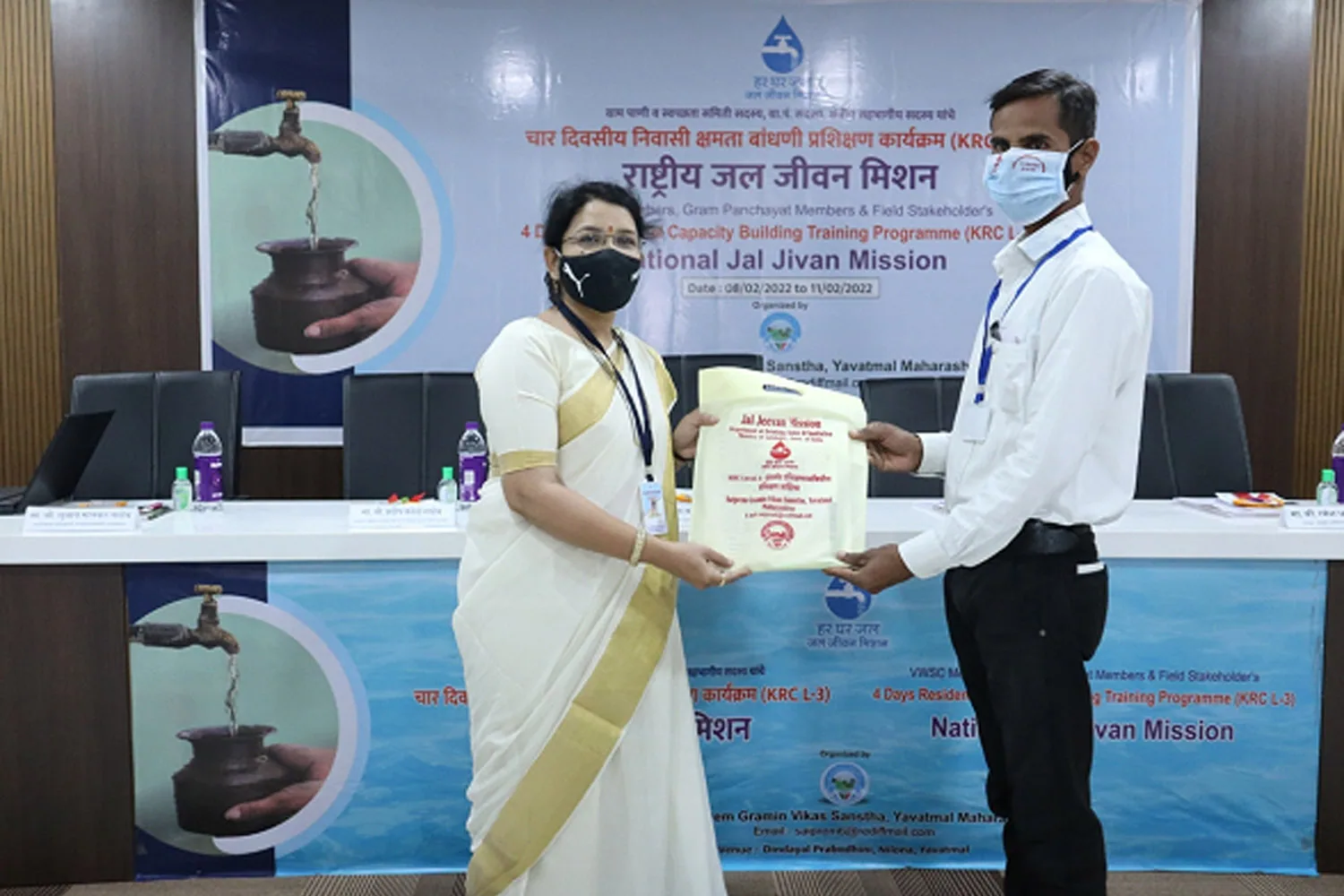
A certificate being presented at the KRC Level 3 training, with the programme banner recording 8–11 February 2022 behind
Plate 10 · A certificate presentation at the KRC L-3 training. The banner records the dates 8–11 February 2022.

A closer look · 8–11 February 2022

Four days
in February.

From 8 to 11 February 2022, SGVS organized a four-day residential capacity-building programme in Yavatmal district under the Jal Jeevan Mission KRC framework. The organization’s account records village representatives, Gram Panchayat members, village water and sanitation committee members, self-help groups, implementation agencies and other local participants.

  1. Day 1 · 8 Feb

    Understanding the mission

    An introduction to Jal Jeevan Mission, safe drinking water, hygiene, stakeholder roles and the importance of community participation. Invited resource people led demonstrations and discussions.

  2. Day 2 · 9 Feb

    Planning at village level

    Participants reviewed the first day and discussed village action plans, planning, design and implementation. The programme included presentations and an online interaction with a water-sector resource person.

  3. Day 3 · 10 Feb

    Learning from the field

    The group visited Nagapur village in Umarkhed block. The group met local representatives, studied village water systems and carried out a participatory rural appraisal.

  4. Day 4 · 11 Feb

    From learning to local action

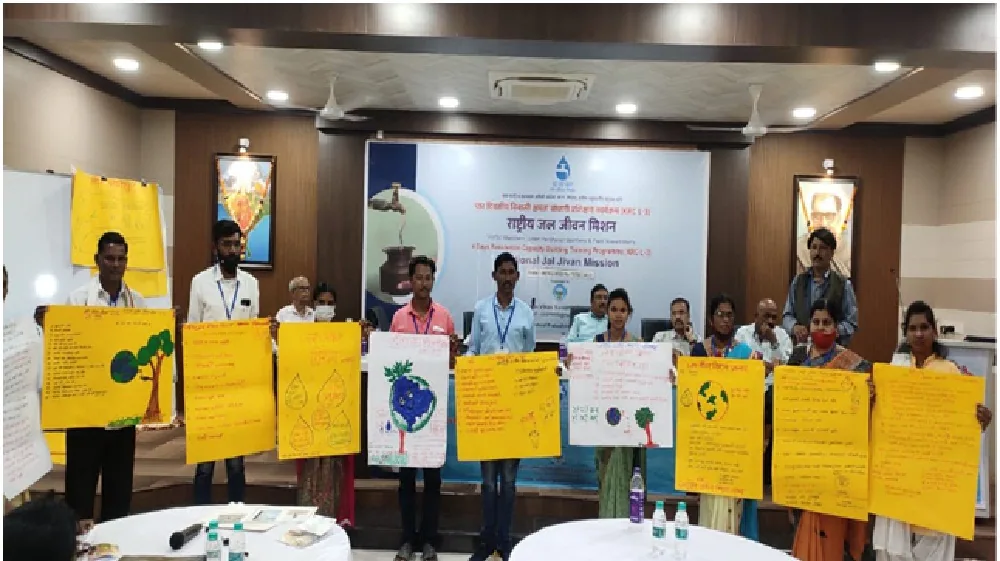
    The final day covered monitoring water infrastructure, village-level management and the Har Ghar Jal declaration protocol. Participants presented their work and received certificates.
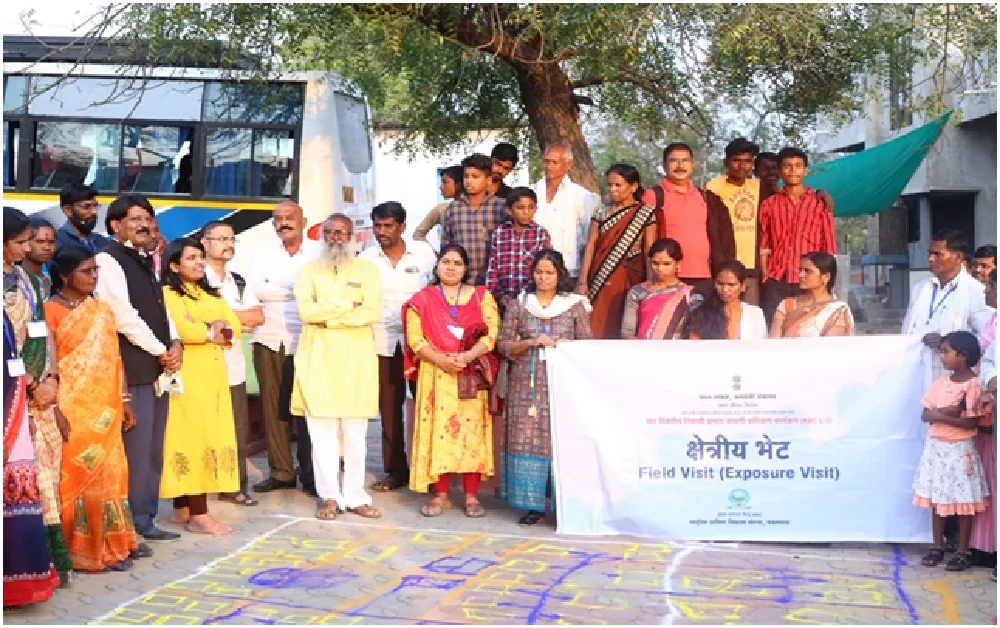
A group standing with a Field Visit banner during the Jal Jeevan Mission training programme
Plate 11 · A field visit group during the Jal Jeevan Mission training programme.

The field visit

Seeing a village water system
up close.

On the third day, participants travelled to Nagapur village in Umarkhed block. The original account describes a discussion with local representatives, a visit to the water purification room and water supply infrastructure, and a participatory rural appraisal exercise.

The visit connected classroom planning with local experience and gave participants a shared setting for discussion.

View the complete training gallery

From the gallery

Inside
the programme.

Fifteen photographs document the training programme, speakers, group work, field visits and newspaper coverage. Participant names are not recorded for most images.
A certificate presentation at the Jal Jeevan Mission KRC L-3 training, with the 8–11 February 2022 banner behind
Participants holding hand-drawn charts at a Jal Jeevan Mission training programme
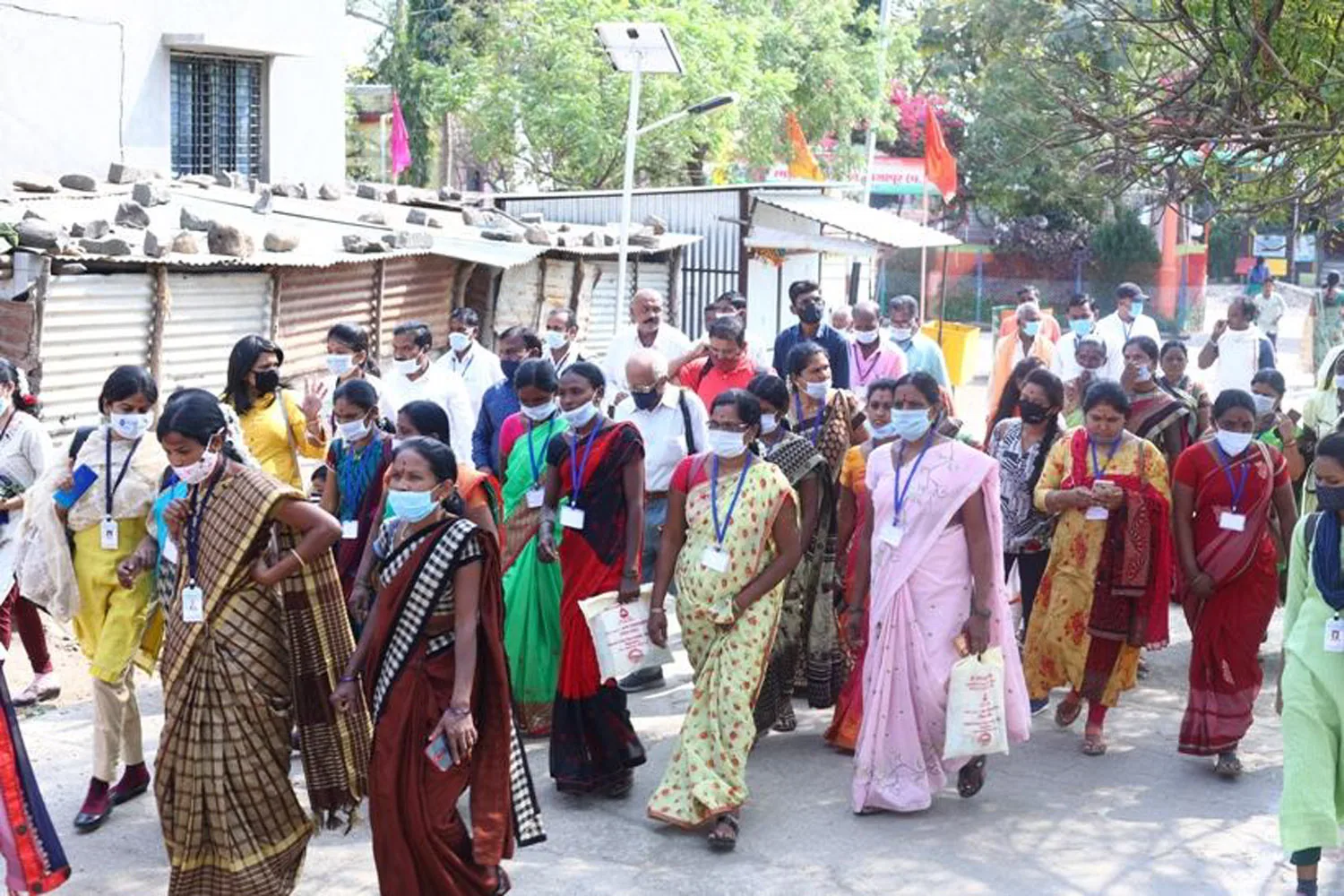
Women walking together during a Jal Jeevan Mission training programme
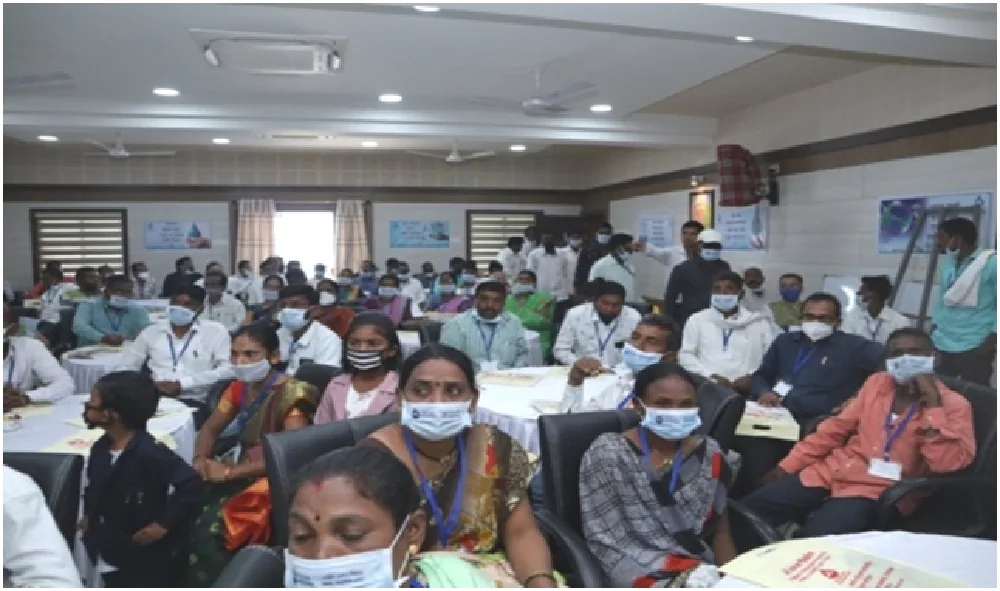
Participants seated in a training hall during a Jal Jeevan Mission programme
A field visit group beside a programme bus, with a Field Visit banner
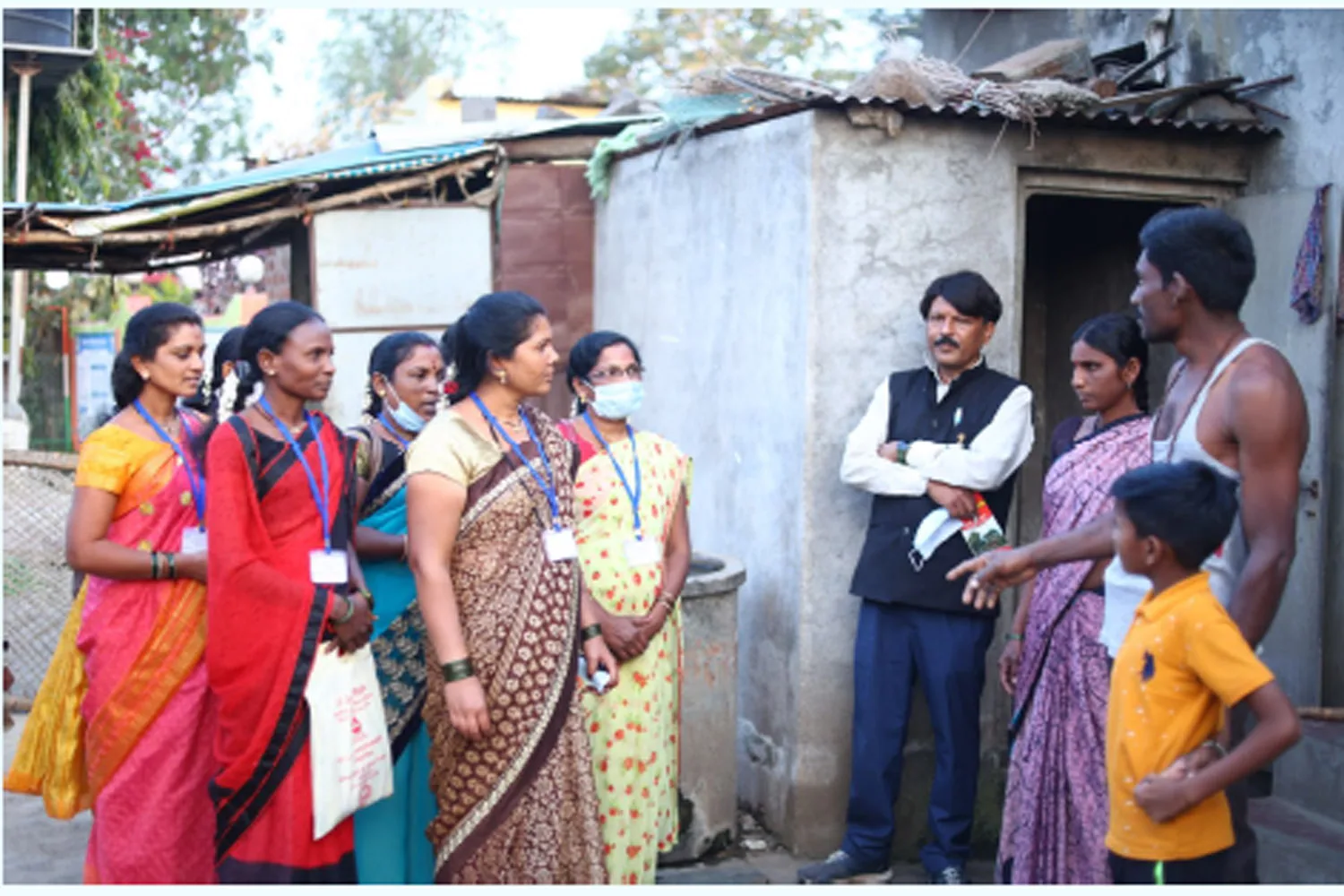
Women and a child speaking with a local resident during a field visit
15 photographs · SGVS gallerySee all training photographs

The complete programme account.

Programme activities include village selection, training preparation, speakers, daily activities and field observations.

Read the archived JJM KRC account
Jal jeevan mission is the dream of our beloved PM mr. Narendra modije. His aim is to provide Safe drinking water in every rural household with the help of FHTC ( Functional household tap connection) By the year 2024. It also aims to reuse the water by Grey water management..in which the waste water coming from our house is filterd and then used to water landscape plants and trees or even used for irrigation. The key component of the mission is to communicate and educate everyone about water as it should be everyone's top priority. Recently spgv sanstha has successfully completed the iwmp program and while doing this program our team looked at the other problem too which was that there was no clean drinking water for the people, the women has to walk long distance to get Water, which was not even clean or safe to drink. There was so much trouble in getting clean drinking water. And seeing people suffering saiprem gramin vikas sanstha decided to join the Jal Jeevan Mission. Overall India our sanstha is one of the 113th krc one to work on this mission. Saiprem gramin vikas sanstha has allowed 3 states under it. Maharashtra,Madhya Pradesh and Chattisgarh. In Maharashtra two district were alloted Yavatmal and Pune, in MP Hoshangabad and in Chattisgarh Dantewada and Balodabazar. We were informed to take two programs first..so we decided to take the first two programs in Yavatmal district. We decided our venue as Nilona dindayal prabhudini. Because all our requirements were available there. It had great views, more like a hill station, these was so much of greenery the halls were big and well maintained it was a residential place, there were rooms for members and all 3 meals were provided. The place was clean and I would say it was the best place in our district. After this we foced on the training materials, we prepared it by our self. All the information and ideas were given by our team members. The kit was given in Bag which had 4 books in which the books were written according to the session and day wise and these books were prepared by expertise along with it . writing pad, pen an I card and mask.. We focused on the mask and had jal jeevan mission printed on it. Then we selected villages from Yavatmal block which are Chicbardi,chapdo,ghodni,zab,and hiviri As per guidline to keep the saifty measure the limit of people was 60. Our team visited the selected villages and personally invited the members according to the guideline to be a part of the training program. Each member had there name on it.The participants of the Capacity Building Training Program are: Sarpanch, Gram seawk , Members of Gram Panchayat, Zilla Parishad, PRI institutions, VWSC (Village Water Sanitation Commitee), Paani Samitis. Implementation support Agencies, Self Help Groups, Water user contimittees.Village Functionaries, and other volunteers. Our organization has successfully organized 4 days residential capacity building program as per the prescribed framework received from NJJM. The training program was held on 8-2-22 to 11-2-22.The center was ready to welcome eveyone, it was decorated and colourful with the help of flowers and rangolie. To make it convinent for the people. Bus was sent to pick up and drop them. As the people arrived first the registration took place, masks and I cards room keys were given to them. While heading to the hall sanitization was done in which oxygen level,temperature and sanitizer was given And we even checked if they have been vaccinated with 2 does.. When Everyone came in the hall they saw all the quotes written about jal Jeevan mission sticked to the hall. First the program was enograted by respected Mr.Manoj kumar Chaudhar sir Deputy CEO, Mr. Ramesh Bhanwe sir and KRC module office Mrs.Namrata Gandhe. Then Mr. Pradip Kolhe sir executive engineer of water supply and Mr Prashant patil sir district health media officer. It was an honour for us to have these people to start our training program by explaining everyone about the jjm mission. Mr Vijay Gawali demonstrate on how to test the water and weather it is suitable for drinking or not. Mister Prashant patil talked about importance of clean water. Mr. Kolhe sir directed us about the scheme and also said that that good quality material should be used for water supply scheme.he also technically guided about well And tank. Mr.Chaudhar sir talked about the importance of the yojana. And how everyone should be a part of it. And how it can finish unemployment in the village.ex- local electrition and plumber motarman,fitter can provide service in there village. And everyone should patiently learn about the jjm mission and implement it in there villages.and they even appreciated the sanstha for the great arrangements done for the training program. The Opportunities,roles and responsibilities of stalk holders was also discussed.In between some activities were taken to keep the members active and then the lunch break. After that the second half session took place in that the development of responsible and responsibility leadership were discussed, and how the quality of water is important for survival. At the end of the day the community participation was also talked about. After the 1st session was done. Many people stayed back and they had a very good Time at the training center, they sang songs and played some games in the evening. On Day 3 the field visit was planned to Nagapur village block umarkhed district ytl. Secretary of the Sanstha Miss. Rita Bhanwe was also present on that day.All the members were informed to come to the center at 7 in the morning then from there all the members were seated in the Bus arranges by the sanstha. In the bus all the members had so much fun. They played antakshari and many more games in the bus. After reaching at the venue the village sarpanch welcomed us all with warm wishers and flowers first we headed to the hall and honorable shree Chingroa Kadam sir the Z.P member,sarpanch, and all memebrs of grampanchayat and VWSC members were presnt there and talked to us about there village and how they procgrssed and developed there village by public participation.then we saw the whole village, One thing everyone observed about the village was that no garbage was on road. The schools there were also well maintained, It even had computer lab, which was also done by public participation. After that we headed to Water purification room, in every area there were boar and over heas water tanks and the clean water was supplied to all the houses in the village through tap through public participation. And we then we saw that our mission Har ghar NAL har ghar jal was happening successfully there. Later we visited the cowshed, it was a government scheme and there all the requirements for the cows were provided. Which made the village more clean. After that we saw the solar panels which was placed on top of the hall. Which helped the villagers get hot water for bath, and jt also saved a lot of electricity for water supplt scheme.After that the PRA (participatory rural appraisal )was done. It is a very effective activity to ensure the participation of maximum people to make success of jjm. By conducting PRA the exchange of information regarding the project can be done.it also involves the community for planning, implementation of rural water supply scheme. After the PRA was done every one understood how it is useful for people and then we thanked all the village member's for giving us there time and letting us spend a day there.it was a great experience for everyone. They learned a lot and Even had a good time. While heading back our trainer Mr. Agashe sir gave charts to everyone to perfrom an activity on Har ghar nal se jal..by making a DPR. Everyone were very excited and motivated to make there village also one of the best village and everyone should be provided Clean drinking water . On the last day of the program overseeing of water supply infrastructure during construction by community post implementation monitoring was discussed..As it was the last day of the training, members sung songs , Did some activities like writing there thoughts on Chart paper and presenting it front of everyone. After that Har Ghar Jal Village declaration protocol were discussed and then the field exposure visit was also discussed. grampanchayat as utility for decentralised management was also discussed which means all people should be responsible for there own work.As the day came to an end the session also had to end. And before ending It,certificates were given to all the members for being present for the 4 days program and taking an active part in the Jal Jeevan Mission.

Other water records

The work
around the water.

Watershed development, village water supply and drought-prone area work sit alongside the mission’s training programme.

Water is a shared
responsibility.

SGVS works with village institutions, government departments and training participants to strengthen local capacity for rural water systems.

WhatsApp SGVS