20.
Scheme/ Project Name: Sickle Cell Disease Control
Program
❖ Funding Organization: National Rural Health Mission (NRHM)
❖ Project Area/Work Done Area:
8 Talukas, 34 PHCs, 8 RHs, and 2 SDHs in Yavatmal District
❖ Working Period: 2010 to 2012
❖ Role & Responsibilities:
▪ Role: Implementation Organization
▪ Responsibilities:
➢ Conducted mass screening and diagnostic camps to identify carriers and sufferers of
sickle cell disorder.
➢ Appointed and managed a team comprising 1 District Project Manager, 1 Accountant, 8
Supervisors, and 34 Volunteers for effective project implementation.
➢ Carried out population-based genetic surveys to detect carriers and sufferers.
➢ Organized health education sessions in villages to raise awareness about Sickle Cell
Disease and its prevention.
➢ Provided genetic counseling to families and individuals to prevent the birth of babies with
the disorder.
➢ Conducted marriage counseling to discourage marriages between carriers of the disease.
➢ Facilitated prenatal diagnosis and referral services for suspected cases.
➢ Distributed identification cards to diagnosed patients for proper record and medical
follow-up.
➢ Provided counseling on drug adherence and long-term disease management.
➢ Ensured regular follow-up of patients through volunteers and supervisors to monitor
health status and treatment continuity.
➢ Maintained coordination with District Health Authorities and other stakeholders for
smooth implementation and reporting.
Sickle Cell Disease Control Program
Read more about this programme+
Sickle cell Disease Control Programme.
Sickle cell disease is a group of disorders that affects hemoglobin, the molecule in red blood cells that delivers oxygen to cells throughout the body. People with this disorder have atypical hemoglobin molecules called hemoglobin S, which can distort red blood cells into a sickle, or crescent, shape.
Sings and symptoms of sickle cell disease usually begin in early childhood. The severity of symptoms varies from person to person. Some people have mild symptoms, while others are frequently hospitalized for more serious complications.
The signs and symptoms of sickle cell disease are caused by the sickling of red blood cells. When red blood cells sickle, they break down prematurely, which can lead on anemia. Anemia can cause shortness of breath, fatigue, and delayed growth and development in children. The rapid breakdown of red blood cells may also cause yellowing of the eyes and skin, which are sign of jaundice. Painful episodes can occur when sickled red blood cells, which are stiff and inflexible, get stuck in small blood vessels. These episodes deprive tissues and organs of oxygen- rich blood and can lead to organ damage, especially in the lungs, kidneys, spleen, and brain. A particularly serious complication of sickle cell disease is high blood pressure in the blood vessels that supply the lungs (pulmonary hypertension). Pulmonary hypertension occurs in about one-third of adults with sickle cell disease and can lead to heart failure.
We enhance awareness among the people by holding
Our NGO implemented sickle cell disease programme since Dec. 2010 through NRHM . we are implement this programme in Yavatmal district at 8 Taluka involving 34 PHC and 8 RH / 2 SDH.
1 District Project manager, 1 Accountant, 8 Supervisor and 34 Volunteers have appointed at this programme
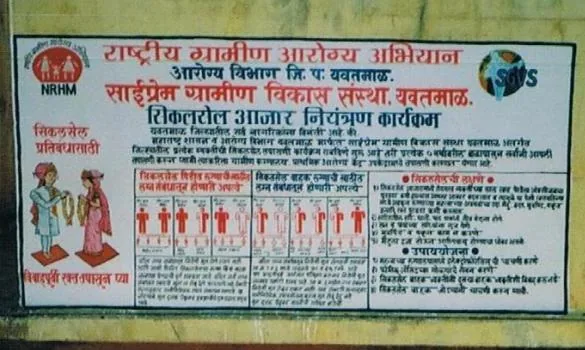
Main objective of the project are to refer each and every person in the vicinity for diagnosis of sickle cell disorder and other genetic defects. Follows up of sickle cell patients. Carry out population genetic survey programs to detect carriers and sufferers. Health education. Genetic counseling: - To avoid birth of baby with sickle cell decease. Marriage counseling:- To avoid marriage between two carrier provide prenatal diagnosis whenever required. Distribute cards to identified patient. Counseling on drug adherence.
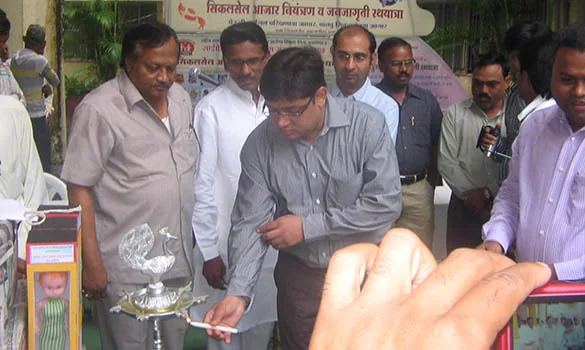
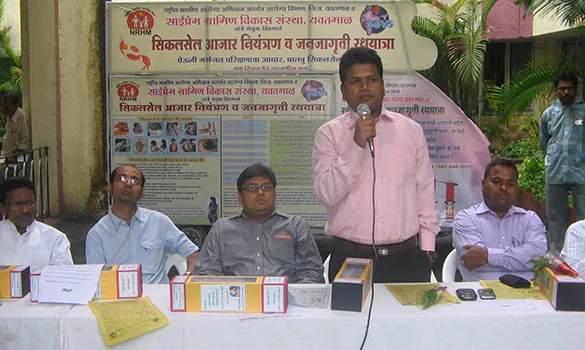
Photographic record.
Plate · SGVS Sickle Cell Disease Control record.
Plate · SGVS Sickle Cell Disease Control record.
Related records
Other work in the record.
Explore related programmes by field, period and place.